
Turning Data Center Waste Heat into Home Heating
Hundreds of companies rely on the servers and IT systems running around the clock in our data centers. They include hospitals, banks, government agencies, service providers, industrial companies, and cloud providers. But data centers are not just essential to businesses. They also support much of our everyday digital lives.
Photos, music, emails, streaming, and social media all depend on IT infrastructure that processes data and keeps digital services available around the clock. Millions of people use these services every day. Behind the scenes, countless servers are constantly processing vast amounts of data. And in doing so, they generate heat. A lot of it.
Turning Waste Heat into Heating Energy
At Green, we put this heat to use. We recover it from our data centers and make it available for heating and other applications. Since our data centers began operations, we have been using waste heat directly on campus. Now we are taking the next step: The first homes in Dielsdorf are being heated with waste heat from our data centers.

Using waste heat to heat entire neighborhoods requires the right infrastructure: an energy center to prepare the heat for distribution and a district heating network to deliver it to buildings. Energy 360° has built a new energy center on our campus and installed extensive district heating pipelines. The energy center officially began operations on November 19, 2026, with the first residential buildings already connected to the network.
From Dielsdorf to Regensdorf and Beyond
What starts with a handful of buildings today will expand significantly in the coming years. The district heating network is being developed in stages, with construction of the pipelines to Regensdorf already underway.
In addition to Dielsdorf and Regensdorf, the network will extend to Niederhasli, Steinmaur, Buchs, and Dällikon. Industrial and commercial businesses with substantial heating requirements can also benefit. The advantage is clear: Using heat that would otherwise go unused can replace fossil fuel-based heating systems. This turns an existing local energy source into a practical contribution to lower-carbon heating across the region.
Waste Heat Recovery Starts with Data Center Design
Effective waste heat recovery requires the right technical infrastructure from the outset. That is why heat recovery is an integral part of Green's reference design for new data centers and is incorporated into the earliest planning stages.
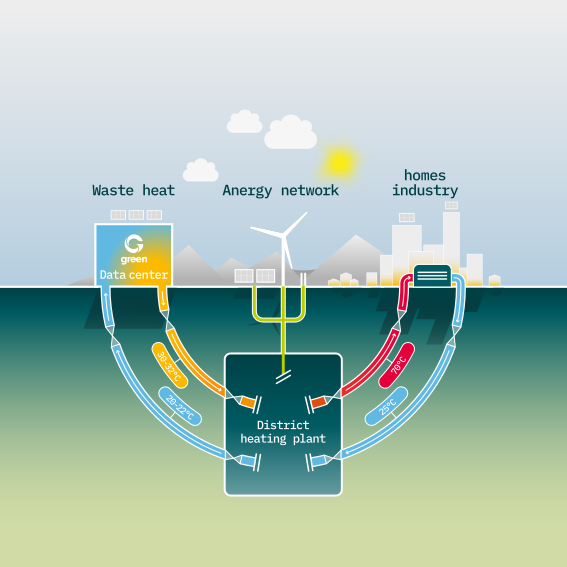
At the energy center, the recovered heat is brought to a temperature of approximately 70°C before being fed into the district heating network. The cooled return flow from the network, in turn, supports data center cooling and reduces the energy required for cooling operations. This closed-loop energy system allows the energy to be used more than once.
Our approach goes further. Across our data center locations, we focus on energy-efficient cooling technologies, closed-loop cooling systems that do not consume water during the cooling process, and waste heat recovery. Digital infrastructure requires energy. That makes it all the more important to use energy efficiently and make the most of available resources.
Data Centers Have a Role in the Future Energy System
Data centers do more than consume electricity. They can also contribute to the wider energy system by supplying waste heat for district heating, providing tertiary control reserves through backup power systems when needed to help stabilize the electricity grid, and sourcing electricity from renewable energy sources.
Making this possible requires both technical solutions and close collaboration with energy suppliers, district heating operators, municipalities, and other partners. Dielsdorf demonstrates how this collaboration can create tangible benefits for an entire region.


Data centers are much more than digital infrastructure. By putting their waste heat to use, they become an important part of the energy system.