

Cloud Power. Swiss Control.
At Microsoft Sovereignty Day, the discussion was not about another cloud variant, but about a concrete shift in infrastructure strategy: Which workloads belong in the public cloud, which ones must remain locally controllable, and how can both be connected cleanly? This is where Azure Local becomes relevant. It creates a path between traditional public cloud and owned infrastructure, and makes the questions of data residency, operations, and connectivity negotiable in a new way.
Sovereignty is no longer a niche topic
Data control is becoming a competitive factor. Switzerland’s revised Data Protection Act requires transparent data flows, while FINMA expects financial institutions to apply appropriate safeguards when outsourcing. The market is moving in the same direction. According to Gartner, spending on sovereign cloud infrastructure in Europe is expected to increase by 83 % to USD 12.6 billion in 2026.
Cost pressure is also reshaping decisions. After VMware’s price changes, 86 percent of surveyed companies are reducing their usage; almost half are moving to Hyper-V or Azure. Many are also bringing workloads back from the public cloud — nearly three-quarters of surveyed companies, according to IDC. Any company reassessing its cloud strategy today will inevitably come across Azure Local. There are good reasons for that.
Cloud innovation and data sovereignty are not opposites
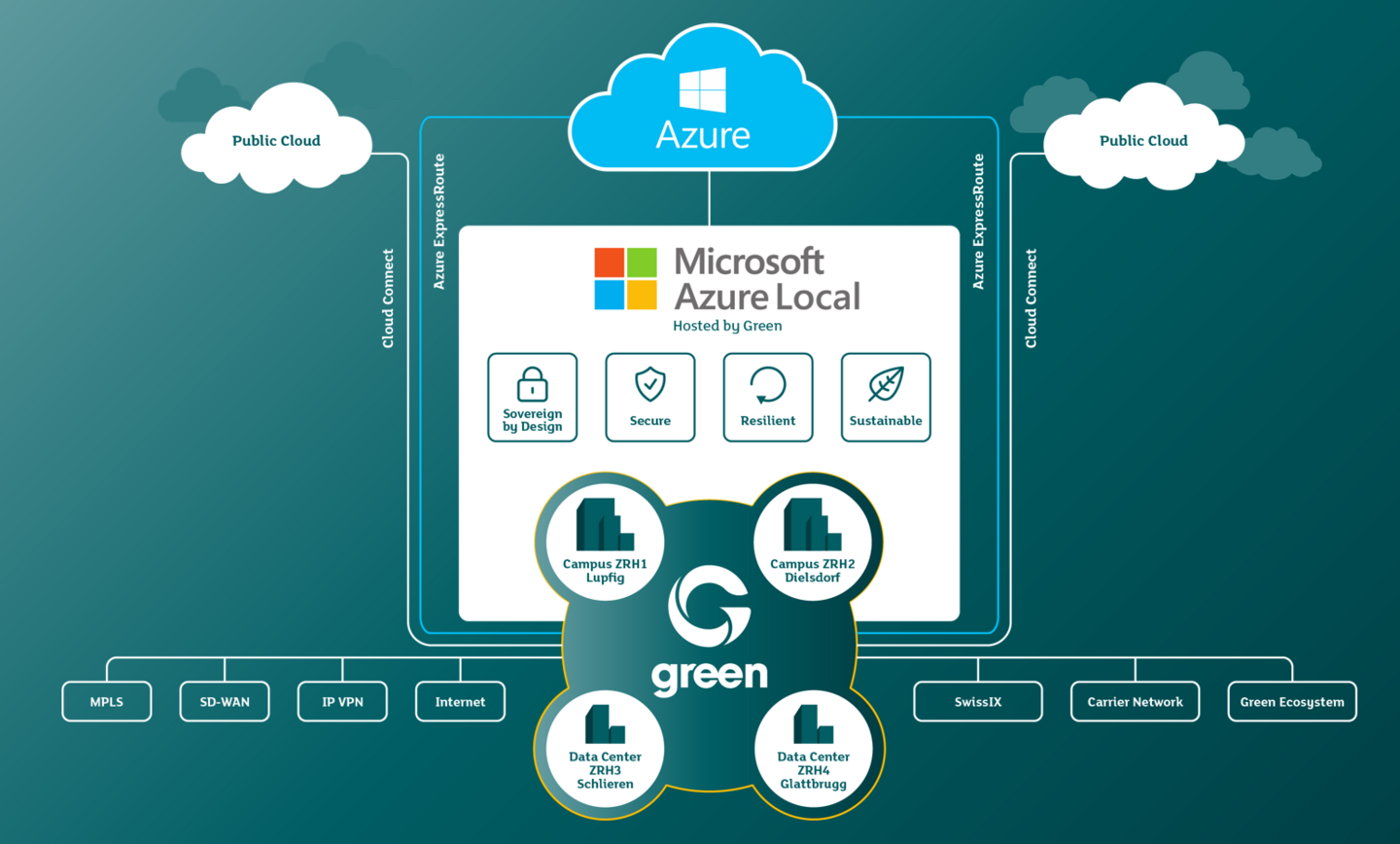
Until now, companies have often had two insufficient options. The public cloud offers speed and scale, but little control over sensitive data. The company’s own server room offers control, but also high effort and aging technology. Azure Local brings both together. The platform moves core Azure services into the data center; applications and data remain in-country, while management runs through the familiar Azure portal.
The biggest concern is that this ultimately means being tied to the cloud again. That’s not the case. In its disconnected configuration, Azure Local can run completely independently of the Azure cloud. Management, access controls, and policies all remain then within the company’s own data center. Even AI models and services such as Exchange and SharePoint can operate without any external connection. The key is choice. Companies can decide for each application where their data resides and how much cloud they want to use.
The data center determines success
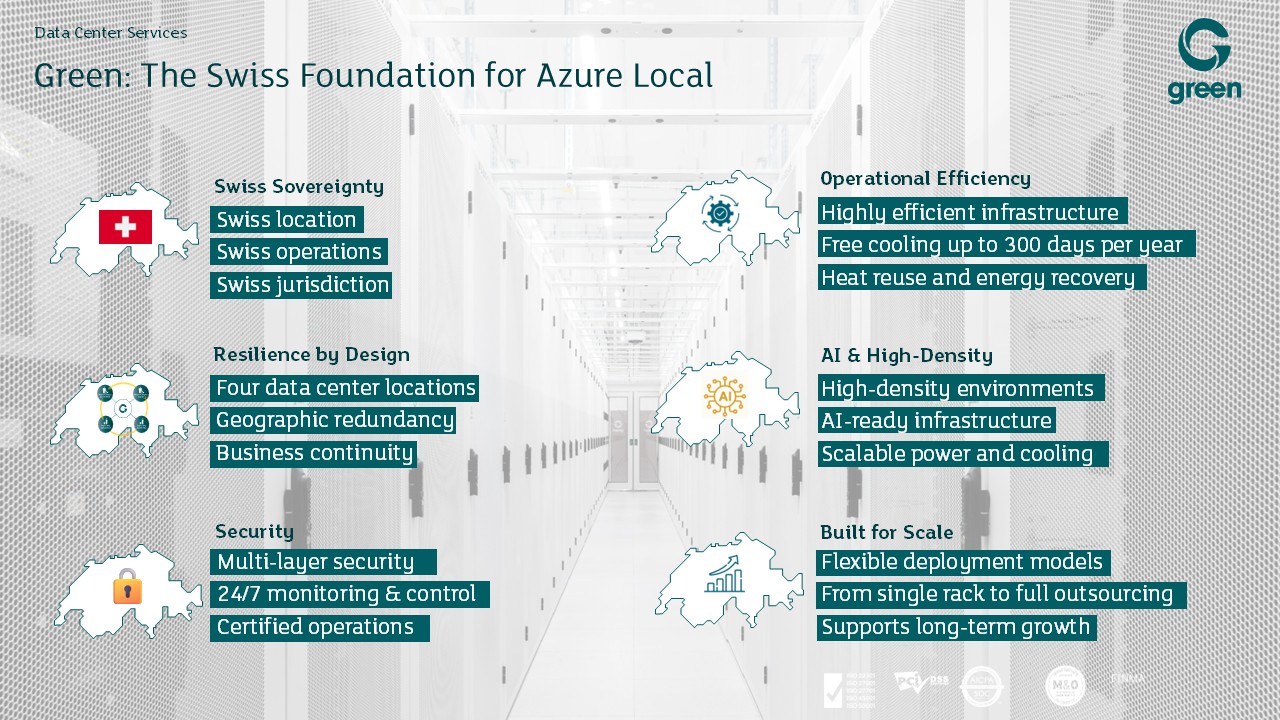
Whether Azure Local runs reliably, securely and with high performance depends heavily on the underlying infrastructure. Software alone ensures neither availability nor performance. A professional data center provides redundant power and cooling, physical security and 24/7 operations. At the same time, modern, energy-efficient data centers enable more resource-conscious operations and a better CO₂ footprint than many in-house server rooms. Green provides four data centers in the Zurich region that meet the highest requirements for availability, business continuity, scalability and energy efficiency.
Moreover Green connects Azure Local to Microsoft Azure via Azure ExpressRoute, keeping the local environment closely integrated with cloud services without routing traffic over the public internet.
Green as the preferred partner in Switzerland
The success of Azure Local depends on the right partners working together. Green provides highly available data center and connectivity infrastructure in Swiss data centers and works closely with Microsoft, hardware partners and experienced integrators such as ti&m. This creates powerful and sovereign Azure Local environments that combine cloud innovation with Swiss data sovereignty.
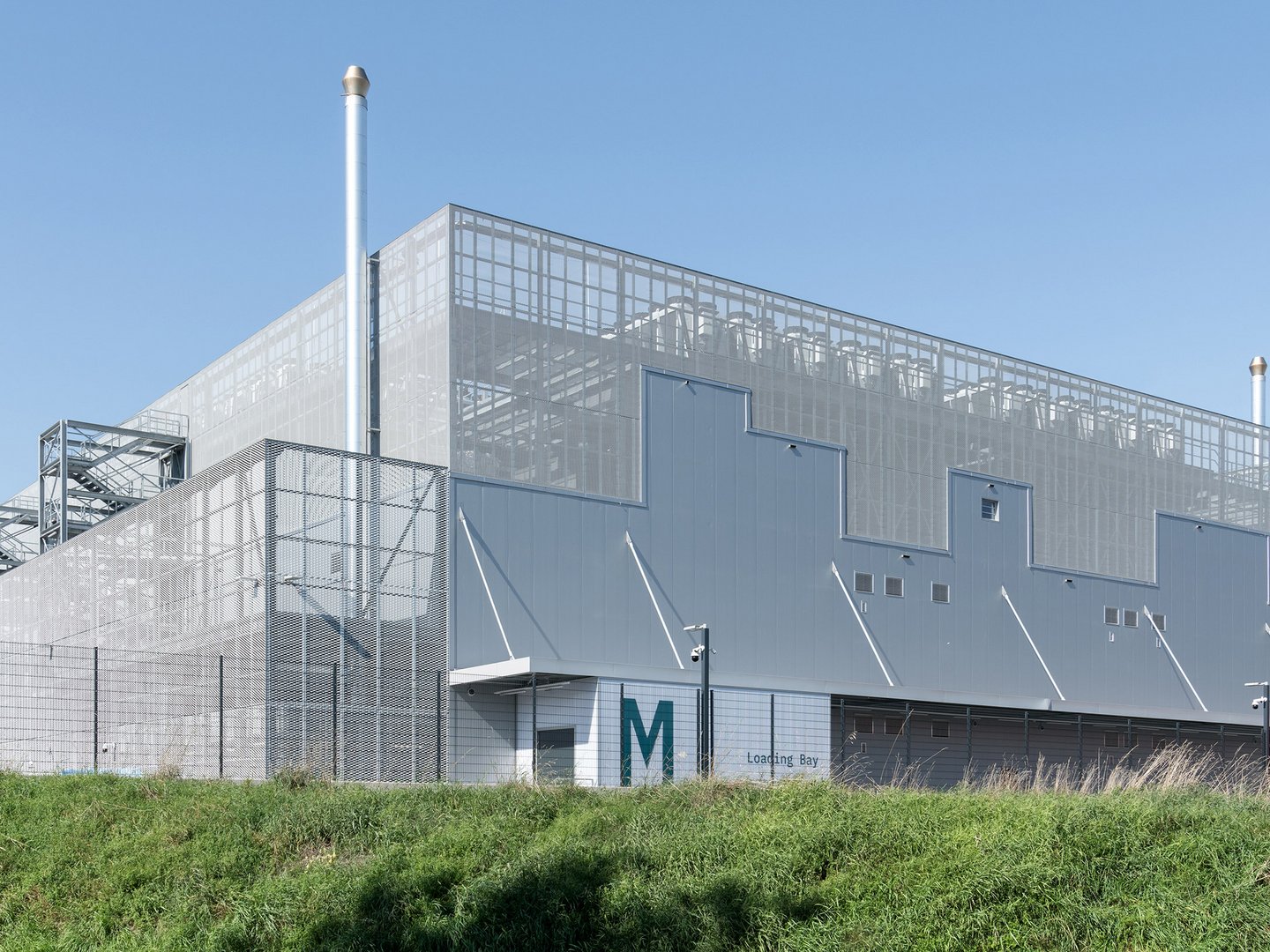
For companies, this means a short path from strategy to execution. The infrastructure can adapt flexibly to growing requirements and provides the foundation for reliable operation of business-critical workloads. The Swiss location combines data sovereignty, high availability, business continuity and scalability. At the same time, energy efficiency and sustainability are becoming increasingly important in infrastructure decisions. This is how Green combines the innovation power of the cloud with powerful Swiss infrastructure that supports data sovereignty, scalability and sustainability in equal measure.
Suitable use cases for Azure Local
The model is well-suited to organizations with high requirements for data residency and availability. This includes financial institutions, healthcare providers, public authorities and operators of critical infrastructure, as well as industrial companies with data-intensive production environments. For them, it matters to prove where data resides and who operates it.
Economically, local operations are worthwhile, especially for predictable, consistently high workloads. From around 100 to 200 virtual machines, Azure Local is often ahead of a pure public cloud setup. Productive AI creates a continuous, dense load that becomes expensive by the hour in the public cloud. Running it at Green makes these costs predictable. Standard applications continue to run in the public cloud, while workloads requiring protection remain local.
Run AI locally without exposing data
AI makes the sovereignty question even sharper, because models need to be close to the data. Azure Local brings powerful GPUs into the local data center and runs AI models where the data resides. Green provides the environment for this, with high power density and scalable power and cooling.
This lets companies bring AI to their data instead of moving data into external environments. Cloud innovation, AI capability and local control reinforce one another. That is the advantage of a sovereign environment in Switzerland.
The next step toward sovereign cloud
Azure Local brings cloud innovation and data sovereignty together; the data center in Switzerland becomes the foundation. Green provides this foundation through four locations, Azure ExpressRoute and sustainable operations. The path starts with an assessment.
Green’s Data Center Readiness Check shows, in just a few minutes, where a company’s infrastructure stands today and which workloads are suited to sovereign operations. The Data Center Strategy Playbook provides the basis for a management decision. For concrete initiatives, a direct conversation is worthwhile: Green’s specialists review the starting point, design the right architecture and define effort and timeline.

Do you want to prepare for the future?
Arrange an appointment.
We have time to talk